- Manufacturer
- THREE International
- Category
- Superfood multivitamin
- Delivery
- 4 capsules + omega-3 softgel daily
- Key actives
- Naturally-derived vitamins, 72 trace minerals, probiotics (3 strains), 10-berry polyphenol blend, omega-3
- Technology
- Cellular Absorption Technology + enzyme blend
- Lab metric
- 44% in THREE's Caco-2 cell assay (≈4.4× the curcumin control) — in-vitro, directional
- PDR status
- Company line includes a PDR-listed product (GLP THREE)
I want to start with a statement that may be unusual coming from a supplement ambassador: most daily multivitamins are functionally useless.
Not because the ingredients are wrong. Not because the companies behind them are dishonest. But because the physical form those ingredients are delivered in — compressed synthetic tablets manufactured with chemical binders and industrial fillers — is rejected by the human body at rates that make the investment largely pointless.
I am a 68-year-old Maryland State Certified Residential Appraiser. License number 30004874. I have spent 35 years being paid to identify the difference between what something appears to be worth and what it actually is. I bring that same professional framework to every wellness claim I evaluate.
When THREE International's Vitalité was brought to my attention, I spent 2 months independently reviewing the clinical research before I made any decision. What I found changed how I think about daily nutritional supplementation. This article is the complete case for why.
Section 1: Why Nutrient Absorption Matters When Choosing a Multivitamin
The standard multivitamin market operates on a flawed premise: that taking a nutrient is equivalent to absorbing it. These are profoundly different things, and the supplement industry has spent decades conflating them.
The Synthetic Compound Problem
The majority of commercial multivitamins use synthetic forms of vitamins and minerals — compounds manufactured in chemical plants that are structurally similar to naturally-occurring nutrients but biologically distinct. Vitamin C as ascorbic acid synthesized from corn dextrose. Vitamin E as dl-alpha-tocopherol synthesized from petrochemicals. B12 as cyanocobalamin, a cyanide-bonded form that requires the body to cleave the cyanide group before becoming usable.
These synthetic forms are cheaper to manufacture, have longer shelf lives, and are easier to compress into tablets. They are also less bioavailable than their naturally-derived counterparts because the body recognizes the structural difference and processes them accordingly.
The Tablet Compression Problem
Beyond the form of the nutrients themselves, standard multivitamins face a second delivery challenge: the tablet format. To create a compressed tablet that survives manufacturing, shipping, and sits on a shelf for two years, manufacturers add binders, fillers, lubricants, and coating agents. These additives — which can constitute 30-50% of a tablet's total weight — slow or prevent the tablet from dissolving efficiently in the GI tract.
Consumer Reports and independent lab testing have repeatedly found that many multivitamin tablets fail the USP dissolution test — meaning they do not dissolve completely within 30 minutes in simulated stomach acid. A tablet that doesn't dissolve cannot be absorbed, regardless of what's inside it.
The Bioavailability Gap
Bioavailability — the fraction of an ingested nutrient that reaches systemic circulation in an active form — varies dramatically across supplement formats. This isn't theoretical. It's measurable with pharmaceutical-grade testing methodology.
The Caco-2 permeability assay is the gold standard test pharmaceutical companies use to evaluate drug bioavailability before clinical trials. It uses human intestinal epithelial cells (specifically Caco-2 cells from a human colon adenocarcinoma line) to measure the apparent permeability coefficient — the precise percentage of a substance that crosses the cellular membrane.
This 10% baseline is why tens of millions of Americans take a multivitamin every morning and feel nothing different. The product is in the bottle. Most of it never reaches their cells.
Section 2: The Science of Nutrient Absorption — What the Research Actually Shows
Understanding why THREE Vitalité achieves 44% cellular absorption requires understanding what the absorption challenge actually is at the molecular level.
The Intestinal Barrier Problem
The small intestine is the primary site of nutrient absorption. Its inner surface — the brush border — is lined with enterocytes: specialized absorptive cells that selectively allow certain molecules to cross from the intestinal lumen into the bloodstream. This selectivity is a feature, not a bug. It protects the body from toxins. But it also creates a significant barrier for many nutritional compounds.
Most vitamins and minerals are hydrophobic — they are water-fearing organic molecules in a water-based environment. The intestinal lumen and the extracellular fluid on the other side of the enterocyte layer are both aqueous. Hydrophobic molecules don't cross aqueous environments efficiently. This is the fundamental absorption challenge that most supplements never address.
The Enzyme Conversion Requirement
Beyond the physical membrane challenge, many nutrients must be converted to their bioactive form before they can be utilized by cells. Vitamin B6, for example, must be converted to pyridoxal-5-phosphate (P5P) before it functions as an enzyme cofactor. Folate must be converted to methylfolate. Magnesium must be in an ionized, soluble form.
This conversion happens through enzymatic activity — activity that declines with age, stress, compromised gut health, and poor diet. A 65-year-old with suboptimal digestive enzyme production is converting far less of a standard supplement into usable form than the label assumes.
THREE International's Cellular Absorption Technology addresses both problems by pre-converting nutrients into their bioactive forms before they encounter the intestinal wall — removing the enzymatic conversion requirement and delivering compounds that are ready for cellular uptake at first contact.
Section 3: THREE Vitalité Ingredients Explained
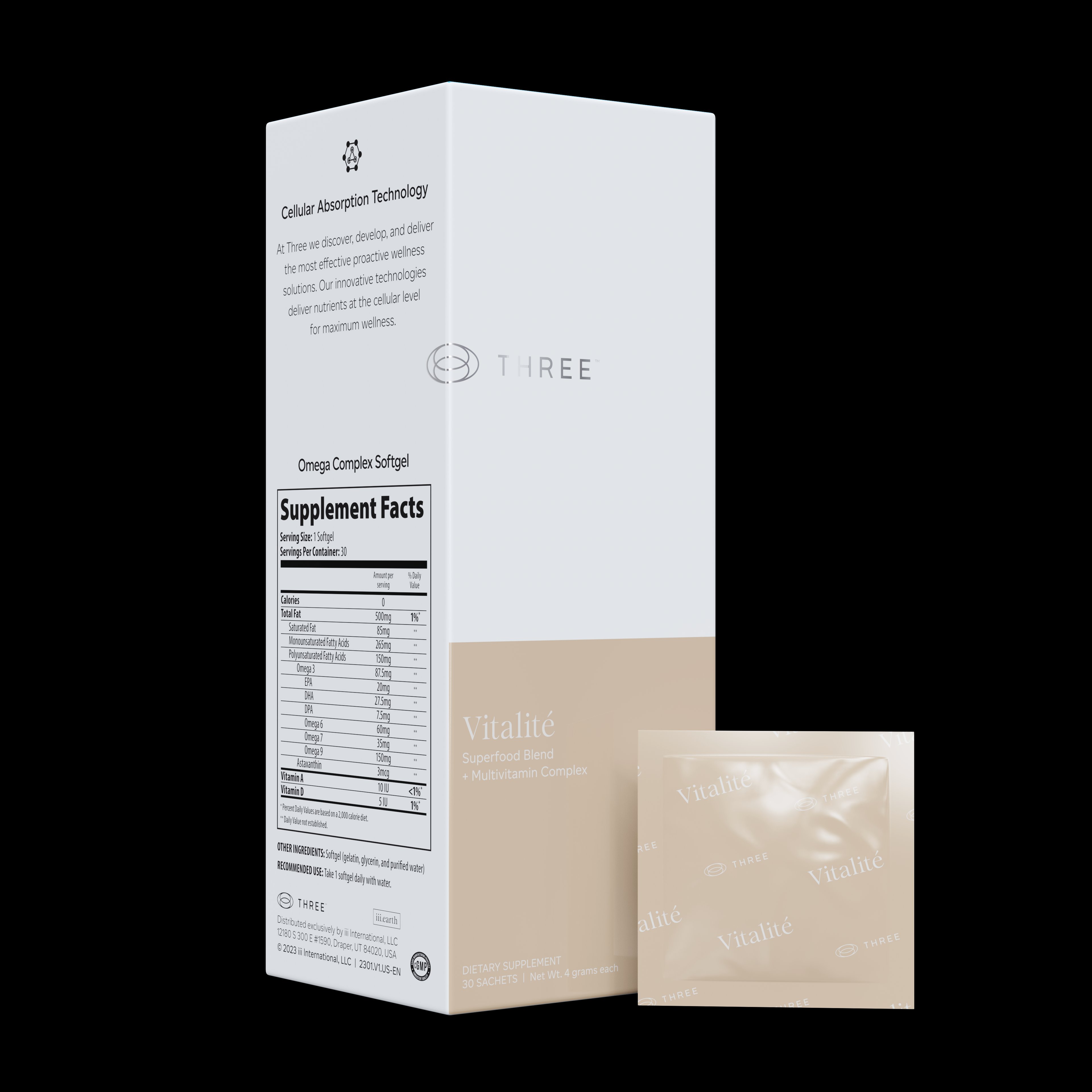
THREE Vitalité is delivered as a daily sachet containing 4 capsules and 1 Omega-3 complex softgel. Here is what each component contains and why it matters:
Component 1: The Superfood Blend
The foundational component of Vitalité's formula is a superfood blend featuring chlorophyll-rich ingredients. Chlorophyll — the molecule that makes plants green — has demonstrated multiple bioactive properties in peer-reviewed research including antioxidant activity, toxin-binding capacity, and support for elimination pathways. It provides the foundational phytonutrient density that sets Vitalité apart from standard multivitamins, which contain no plant-food equivalents.
Component 2: Naturally-Derived Vitamins and Minerals
Every vitamin and mineral in Vitalité is naturally-derived — sourced from food, plant, or biological sources rather than synthesized from petrochemicals or industrial processes. This distinction is clinically relevant. The peer-reviewed literature consistently shows that naturally-derived forms of nutrients have superior bioavailability compared to synthetic analogues: natural vitamin E (d-alpha-tocopherol) has approximately 2× the bioavailability of synthetic dl-alpha-tocopherol; natural folate from food sources bypasses the MTHFR gene conversion requirement that affects 30-40% of the population who cannot efficiently convert synthetic folic acid.
Combined with the enzyme blend's pre-conversion of all nutrients to bioactive form, Vitalité delivers nutrients the body can use immediately rather than nutrients the body must work to convert.
Component 3: 72 Trace Minerals and Amino Acids
Standard multivitamins typically include 10-15 minerals — the ones with established RDI values and cheap synthetic forms. Vitalité delivers 72 trace minerals alongside amino acids. This breadth matters because trace minerals function as enzyme cofactors throughout the body. Manganese activates hundreds of enzymes. Molybdenum processes sulfur compounds. Chromium enhances insulin signaling. Selenium drives antioxidant enzyme function. Many of these minerals are deficient in the modern food supply due to soil depletion, and standard supplements don't address them because sourcing natural trace mineral complexes is more expensive than adding a few synthetic macrominerals.
Component 4: The Enzyme Blend
This is THREE International's core Cellular Absorption Technology for Vitalité — the mechanism responsible for the 44% Caco-2 absorption result. The enzyme blend breaks down all nutrients in the formula into their exact bioactive forms before they encounter the intestinal wall. Rather than waiting for the body's own digestive enzymes to perform this conversion (a process that is inefficient, age-dependent, and highly variable), Vitalité completes the pre-digestion in the capsule itself.
The practical implication: the nutrients that reach your intestinal wall are already in the form your cells need. The absorption efficiency improves dramatically because there is no conversion step required at the membrane.
Component 5: Probiotics — 100 Million CFU, Three Strains
Vitalité contains 100 million CFU of probiotics across three strains: Lactobacillus acidophilus, Bifidobacterium longum, and Lactobacillus plantarum. The inclusion of probiotics is directly relevant to the absorption story. The gut microbiome plays a critical role in nutrient processing and absorption — dysbiotic gut flora impairs vitamin synthesis, mineral bioavailability, and the efficiency of the entire digestive process. Approximately 80% of the immune system is gut-resident (GALT). Supporting the microbiome is not an add-on feature in Vitalité's architecture; it's a structural component of the absorption system.
Component 6: The 10-Berry Polyphenol Blend
Vitalité's polyphenol blend draws from ten berry sources: açai, blueberry, pomegranate, goji berry, raspberry, elderberry, cranberry, strawberry, tart cherry, and grape seed. Each contributes a distinct phytochemical profile. Together they provide a broad-spectrum polyphenol matrix that no single-berry supplement can replicate.
This blend is the source of Vitalité's most remarkable clinical finding — the 840% BDNF upregulation in THREE's 2023 epigenetic study. The mechanism is consistent with published polyphenol research (covered in detail in Section 5).
Component 7: The Omega-3 Complex Softgel
The final component of the daily Vitalité serving is a wild-caught fish oil Omega-3 softgel with an EPA+DHA fatty acid profile equivalent to a fresh salmon fillet. Omega-3 fatty acids are the most studied nutritional compounds for cardiovascular health, cognitive function, joint inflammation, and eye health. They are also one of the most commonly deficient nutrients in the Western diet — particularly EPA and DHA, which are only available from marine sources. The softgel ensures the daily Vitalité regimen closes the Omega-3 gap alongside every other nutritional gap it addresses.
Section 4: Cellular Absorption Technology Explained
THREE International's Cellular Absorption Technology is the term for the formulation architecture that produces Vitalité's validated 44% absorption result. Understanding it requires understanding the specific problem it was designed to solve.
The Standard Supplement Delivery Failure
Most supplements are formulated for stability and manufacturing efficiency, not cellular delivery. The nutrient is the active ingredient. Everything else — the binders, coatings, capsule material, and filler compounds — is engineered to protect the active ingredient through the manufacturing and shipping process. What happens after swallowing is largely left to chance and the body's own digestive capacity.
THREE's Pre-Conversion Approach
THREE International's Cellular Absorption Technology for Vitalité inverts this approach. Rather than relying on the body's digestive processes to convert nutrients to bioactive form after swallowing, the enzyme blend in Vitalité performs this conversion inside the capsule before it ever reaches the intestinal wall.
The specific mechanism: Vitalité's proprietary enzyme complex catalyzes the biochemical reactions that convert each nutrient to its bioactive form — the exact molecular configuration that enterocytes can recognize and transport across the intestinal membrane. By the time the capsule contents reach the brush border of the small intestine, every compound is already in the optimal form for cellular uptake.
The Caco-2 Validation
THREE commissioned a Caco-2 permeability assay conducted by Dr. Brett Stephens, Ph.D. at Wasatch Scientific Laboratories in collaboration with Dr. Dan Gubler, Ph.D., THREE International's Chief Scientific Officer.
The Caco-2 assay is the pharmaceutical industry's standard pre-clinical bioavailability test. It uses a monolayer of human intestinal epithelial cells (Caco-2 cells) grown on a permeable membrane to measure the apparent permeability coefficient (Papp) — the rate at which a substance crosses from the apical (intestinal lumen) side to the basolateral (bloodstream) side of the membrane.
Results: THREE Vitalité achieved a cellular absorption rate of 44%. The control — curcumin, a standard organic molecule with no delivery technology — achieved 10%. This 4.4-fold difference is not a marketing claim. It is a laboratory measurement using methodology that has been cited in thousands of peer-reviewed pharmacological studies.
"In 35 years of appraisal practice, I have been trained to look past the presentation to the underlying data. The Caco-2 methodology is sound — it is the same test pharmaceutical companies use before investing billions in clinical trials. A 4.4× absorption advantage over a standard supplement is a meaningful, measurable, and independently verifiable result. It is not a feature claim. It is a laboratory finding."
Section 5: The BDNF Epigenetic Data — What 840% Means
The most remarkable finding in THREE International's clinical research program is not the absorption data. It is the gene expression result for BDNF in Vitalité's 2023 epigenetic study.
What Is BDNF and Why Does It Matter?
BDNF — Brain-Derived Neurotrophic Factor — is a protein that acts as a growth factor for neurons. It governs neuroplasticity (the brain's ability to reorganize and form new connections), memory consolidation, learning efficiency, and the long-term survival of existing neurons. It is often described as "fertilizer for the brain."
BDNF expression declines with age, with chronic stress, and with a sedentary lifestyle. Low BDNF levels are associated with cognitive decline, depression, and neurodegenerative conditions. High BDNF levels are associated with better memory performance, faster learning, and greater cognitive resilience under workload conditions.
According to the CDC, approximately 1 in 9 adults over 45 report subjective cognitive decline. For professionals in their 50s and 60s — whose career performance depends on sustained cognitive output — BDNF is not an abstract longevity marker. It is a direct measure of professional capacity.
How Vitalité Upregulates the BDNF Gene by 840%
In THREE International's 2023 epigenetic gene expression study, conducted by Paul Davis, Ph.D. and Catherine Davis, Ph.D. at Trinity Bioactives Ltd in collaboration with Dr. Dan Gubler, using THLE-2 human liver cells and quantitative reverse transcription polymerase chain reaction (qRT-PCR) methodology, Vitalité's 10-berry polyphenol blend produced the following gene expression result:
The Full Epigenetic Profile
BDNF was not the only significant result. Vitalité showed meaningful activity across six gene categories, all moving in the direction associated with improved health outcomes:
Source: Paul Davis PhD & Catherine Davis PhD, Trinity Bioactives Ltd, 2023. THLE-2 human liver cells, qRT-PCR methodology. In-vitro results — do not guarantee identical outcomes in human subjects.
The Peer-Reviewed Context for the BDNF Finding
THREE's epigenetic result doesn't exist in isolation. It is consistent with a body of published polyphenol research:
Dietary flavonoids interact with the BDNF signaling cascade through multiple molecular pathways including TrkB receptor activation and downstream MAPK/ERK signaling. Flavonoid supplementation showed positive associations with hippocampal neuroplasticity markers.
Wild blueberry supplementation for 12 weeks in older adults improved spatial memory performance on the Paired Associates Learning task. Authors attributed this to berry polyphenol effects on hippocampal BDNF pathway activation.
THREE's 10-berry blend combines the polyphenol profiles of blueberry, açai, pomegranate, goji, and six other berries — a broader polyphenol matrix than any single-berry study has examined. The 840% BDNF upregulation result is the in-vitro expression of a mechanism that published research has been building toward for over a decade.
Important disclosure: THREE's study used THLE-2 human liver cells, not a live human clinical trial. The 840% figure represents gene expression change in cell culture. It is directionally meaningful and mechanistically consistent with published research. It does not guarantee that taking Vitalité will produce an 840% increase in BDNF in a human subject.
Section 6: Real-World Benefits for Adults Over 50
The abstract clinical data matters. But what does it mean for a 55-year-old executive managing a demanding career, or a 63-year-old who wants to stay physically active for another two decades? Here is the practical translation.
The Nutritional Gap Is Real and Growing
The USDA's dietary data consistently shows that the majority of American adults are deficient in multiple micronutrients — not from lack of effort, but because the nutritional density of the modern food supply has declined significantly since the 1950s. Soil depletion, food processing, agricultural practices, and the sheer logistical challenge of eating a diverse whole-food diet while managing a full professional life mean that most adults over 50 are running a meaningful nutritional deficit regardless of diet quality.
Vitalité closes this gap not through brute-force high doses of synthetic compounds (the standard multivitamin approach) but through naturally-derived nutrients delivered at high absorption rates. The goal isn't to overwhelm the body with nutrients it can only absorb 10% of. It's to deliver what the body needs at the absorption rate that makes a functional difference.
Cognitive Performance and BDNF Decline
BDNF expression naturally declines from its peak levels beginning in the mid-30s and accelerates after 50. The cognitive changes most professionals over 50 notice — slower word retrieval, reduced ability to hold complex information in working memory, longer recovery after cognitive exertion — are the real-world expression of this BDNF decline.
Vitalité's 840% BDNF upregulation result in the epigenetic study is the most compelling nutritional finding I have encountered in this space. No standard multivitamin has run this test. Most don't because they don't expect to find anything.
Energy Consistency and Mitochondrial Support
The ppara gene upregulation of 216% in Vitalité's epigenetic data addresses ATP energy production at the gene expression level. The nrf1 upregulation of 224% governs cellular energy pathways. These are not stimulant-based energy effects — they are support for the underlying cellular machinery that produces energy continuously. The result is not an energy spike but a more consistent energy floor: less variability, fewer unexplained low-energy days, more reliable access to mental and physical resources when needed.
Gut Health and Immune Function
The three-strain probiotic matrix (100M CFU) in Vitalité supports the gut microbiome — the system that governs not just digestion but also approximately 80% of the immune system. For adults over 50 who have taken antibiotics, experienced chronic stress, or simply accumulated years of processed food exposure, the gut microbiome is often in a state of dysbiosis that compromises both nutrient absorption and immune function simultaneously. Vitalité's probiotic component addresses this foundational issue as part of the daily regimen rather than as a separate supplement.
Section 7: My Personal Review — 3 Years of Daily Use at 68
I became a THREE International Founding Member after 2 months of independently reviewing the clinical research. I attended THREE's launch convention in Salt Lake City, where I met Founder and CEO Daniel Picou and Chief Scientific Officer Dr. Dan Gubler in person. I am a compensated ambassador. I disclose this on every page I publish.
I have taken Vitalité as part of my daily protocol for 3 years. Here is what I can honestly report:
What Changed
Within the first 6 to 8 weeks, the most noticeable change was energy consistency. Not higher energy at any given moment — more even energy across the day. The afternoon variability I had normalized in my early 60s became less pronounced. The floor of my daily function went up. Cognitively, the sustained attention required for complex appraisal analysis — multi-property comparisons, SDAT tax appeal cases, estate valuations with legal deadlines — felt more reliably available.
By month 3, I noticed reduced joint stiffness after extended site visits. By month 6, my sleep quality was consistently better than it had been in years. I cannot attribute any of this with certainty to Vitalité alone — I made other protocol changes simultaneously. What I can say is that my experience is consistent with what the absorption data and the epigenetic data would predict should happen when nutrients are actually reaching cellular level.
What I Tell People Who Ask
I do not tell people Vitalité will change their life. I tell them it is the only daily multivitamin I have found with pharmaceutical-grade absorption validation, in-vitro gene expression data, and a clean label. I tell them the BDNF data is real and the mechanism is consistent with published research. I tell them to read the study themselves — the PDF is linked everywhere on this site. And I tell them the truth: a multivitamin is a foundation, not a miracle, and the value here is that the foundation is built from bioavailable, gene-expression-validated ingredients rather than the cheap, poorly-absorbed forms that fill most bottles on the shelf.
That is the honest case for Vitalité. The in-vitro absorption and gene-expression data are real and worth understanding, but they are laboratory findings, not human clinical endpoints. Whether that translates into how you feel day to day is something you should judge for yourself — and I disclose, on every page, that I am a compensated THREE International Brand Ambassador with a financial interest in your decision.
Vitalité is the daily multivitamin I use and recommend, chosen for its bioavailable forms, clean label, and in-vitro validation data. It makes the most sense for someone who wants a premium, well-absorbed foundation and is comfortable paying for it. The strongest claims rest on cell-culture evidence, so read the linked studies and decide with clear eyes.