- Manufacturer
- THREE International
- Category
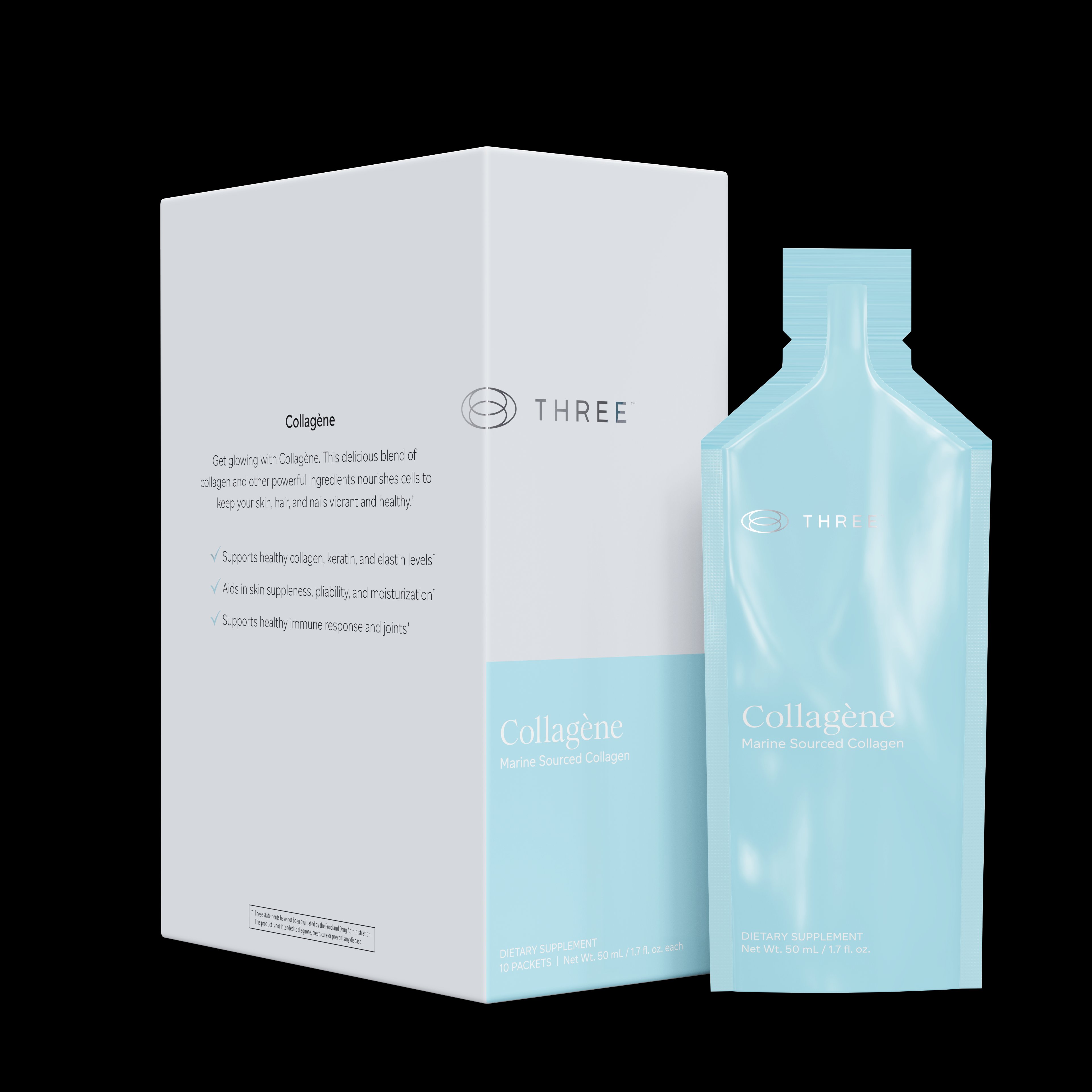
- Liquid marine collagen
- Delivery
- Liquid packet (5g per packet; 10 packets/box; 10-day monthly cycle)
- Key actives
- 5g hydrolyzed marine collagen, hyaluronic acid, biotin, vitamin C, pomegranate polyphenols
- Technology
- Hydrolyzed + micronized peptides
- Lab metric
- 73% in THREE's Caco-2 cell assay (≈7.3× the curcumin control) — in-vitro, directional
- PDR status
- Company line includes a PDR-listed product
There is a simple reason most collagen supplements disappoint: the molecules are too large to be absorbed.
That sentence contains everything you need to understand the collagen supplement market. Collagen is the most abundant structural protein in the human body. The science supporting its role in skin, joint, and connective tissue health is legitimate and well-documented. The problem is not the concept. The problem is the physics — specifically, the molecular size of standard collagen powder relative to the intestinal wall's capacity to absorb it.
I am a 68-year-old Maryland State Certified Residential Appraiser. License number 30004874. I became a THREE International Founding Member after 2 months of independent clinical research. In that review process, THREE Collagène stood out for having the most straightforward and well-documented evidence base of any collagen supplement I encountered. This is the complete case for why.
Section 1: What Collagen Decline Actually Looks Like After 25
Most people think of collagen loss as a skin issue — the lines, the laxity, the reduced elasticity that becomes visible in the 40s and 50s. The visible changes are real, but they are a lagging indicator. The biological decline starts decades earlier and affects far more than skin.
The 1% Annual Decline
Natural collagen production declines at approximately 1% per year beginning in the mid-20s. This rate accelerates significantly after menopause in women — estrogen plays a direct role in maintaining fibroblast collagen synthesis activity, and its decline produces a measurable acceleration in collagen loss. Research has documented that women lose up to 30% of skin collagen in the first 5 years after menopause, with the rate slowing but continuing thereafter.
For men, the decline is more gradual and linear — but by age 60, both sexes have lost significant collagen volume across all the tissue systems that depend on it. The visible skin effects — thinning, reduced elasticity, slower healing — are typically the first noticed because the face is always visible. The joint, tendon, and cartilage effects accumulate more quietly over the same timeline.
Where Collagen Actually Lives
The framing of collagen as a "beauty supplement" has obscured something important: collagen is the structural scaffold of the human body. It comprises approximately 30% of total protein mass and is present in virtually every tissue type:
This full-body distribution is why collagen supplementation — when effectively delivered — has the potential to support multiple systems simultaneously. A product that frames collagen exclusively as a skin treatment is underselling the biology. THREE Collagène's formula reflects this broader understanding.
Section 2: The Collagen Powder Problem — Why the Molecule Is Too Large
The collagen supplement industry generates billions of dollars annually. It has also produced one of the most widespread supplement disappointments among adults who use wellness products consistently. People add collagen powder to their coffee or smoothie for months, see no change, and conclude that collagen supplementation doesn't work.
The conclusion is almost always wrong. The mechanism is right. The delivery fails.
The Molecular Size Barrier
Intact collagen molecules are among the largest proteins in biology. A single tropocollagen molecule — the basic structural unit of collagen — is approximately 300 nanometers long and composed of three intertwined polypeptide chains in a triple helix configuration. For comparison, the intestinal membrane pores through which small molecules pass have effective diameters on the order of single-digit nanometers.
The practical consequence: intact collagen molecules cannot cross the intestinal lining in meaningful quantities. They are broken down by digestive enzymes into their component amino acids — glycine, proline, hydroxyproline — which then enter circulation as generic building blocks. The body can use these amino acids to produce collagen, but it does so according to its own priorities and in whatever tissues currently have the highest demand for structural protein. The skin, joints, and nails that prompted the supplementation are not guaranteed to receive disproportionate benefit from this generic amino acid pool.
What Hydrolysis Changes
Collagen hydrolysis — enzymatic breakdown of intact collagen into shorter peptide chains — produces a fundamentally different outcome. Hydrolyzed collagen is broken into di- and tri-peptide fragments (two- and three-amino-acid chains) that are small enough to cross the intestinal membrane intact through peptide transport mechanisms. These specific peptide sequences retain biological identity that generic amino acids do not.
The most important implication: specific collagen peptides — GPRGPA and GPOGPA among others — have been detected in human bloodstream and identified accumulating in dermal skin tissue after oral ingestion of hydrolyzed collagen. They don't dissolve into the generic amino acid pool. They circulate as recognizable peptides and accumulate in collagen-rich tissues.
Following oral ingestion of hydrolyzed collagen, specific collagen-derived peptides including GPRGPA and GPOGPA were detected in human blood and shown to accumulate in the dermis. These peptides were found to stimulate collagen synthesis by fibroblasts when they reached dermal tissue — a direct mechanism for systemic collagen supplementation to affect skin at the structural level.
Randomized controlled trial: women receiving hydrolyzed collagen peptides (2.5g and 5g doses) showed statistically significant improvement in skin elasticity after 4 and 8 weeks compared to placebo. Authors attributed the effect to dermal accumulation of specific collagen peptides stimulating fibroblast collagen synthesis.
This peer-reviewed detection of specific collagen peptides in skin tissue is the scientific foundation that separates hydrolyzed collagen from standard collagen powder. The peptides that accumulate in dermal tissue and stimulate fibroblast activity are preserved through hydrolysis — and lost through simple digestion of intact collagen.
Section 3: Why Topical Creams Cannot Build Collagen
Before examining what THREE Collagène does, it is worth establishing what no topical product can do — because the beauty industry's marketing of topical collagen is one of the most persistent and most expensive misconceptions in wellness.
The Three Layers of Skin
Understanding why topical collagen is functionally useless requires understanding the architecture of skin:
Topical collagen creams deposit collagen molecules on the epidermal surface. The collagen molecules in a cream are — if anything — larger than those in collagen powder, making transdermal absorption essentially impossible at the molecular level. At best, topical collagen provides temporary surface moisturization through occlusive effect. At worst, it provides false reassurance that something structural is happening while the underlying collagen deficit continues.
The only approach that reaches dermal fibroblasts — the cells that actually produce collagen — is systemic delivery through oral ingestion, circulation, and dermal tissue accumulation. This is what the Asserin et al. (2015) and Proksch et al. (2014) studies document: specific hydrolyzed collagen peptides reaching the dermis through the bloodstream.
"Topical collagen cream cannot build dermal collagen. No cream can. The dermis is two millimeters below the surface. The only path there is oral — and only with peptides small enough to survive the journey from your gut to your bloodstream to your skin tissue."
— Ed Drost, Maryland Certified Appraiser #30004874 · THREE International Founding MemberSection 4: THREE Collagène Ingredients — Every Component Explained
THREE Collagène is delivered as a liquid packet — 10 packets per box, one per day for 10 consecutive days. The liquid format provides faster uptake than capsules and enables the concentration of ingredients at a volume appropriate for pre-absorption palatability. Here is every ingredient and why it is in the formula:
Clean Label
THREE Collagène contains no artificial ingredients, gluten, wheat, dairy, soy, corn, nuts, oats, sugar, artificial preservatives, lubricants, binders, or fillers. Every ingredient in the liquid packet is biologically active — there are no inactive compounds filling out the volume.
Section 5: The 73% Absorption — How Hydrolysis Plus Micronization Works
THREE Collagène achieves 73% cellular absorption in THREE's Caco-2 permeability assay — 7.3× more bioavailable than the standard 10% control. Understanding why requires understanding both steps of the processing that standard collagen powder skips.
Step 1: Hydrolysis
Enzymatic hydrolysis breaks intact collagen molecules into short-chain peptide fragments — primarily di-peptides (two amino acids) and tri-peptides (three amino acids). These small fragments have molecular weights in the range of 200–500 Daltons — well within the absorption range of intestinal peptide transport systems (specifically, the PEPT1 transporter expressed in intestinal epithelial cells handles di- and tri-peptides efficiently).
The PEPT1 transporter is a proton-coupled peptide symporter — it actively transports di- and tri-peptides across the intestinal membrane using the proton gradient. This is an active transport mechanism, not passive diffusion, which means it works against concentration gradients and is far more efficient than the passive diffusion that large intact proteins rely on — and fail at — for absorption.
Step 2: Micronization
Beyond hydrolysis, THREE Collagène's marine collagen undergoes micronization — further particle-size reduction that increases the surface area available for dissolution and membrane contact. Micronization has been used in pharmaceutical manufacturing to improve the bioavailability of poorly soluble compounds for decades. Applied to hydrolyzed collagen peptides, it ensures that even the shortest PEPT1-accessible peptide chains are in a particle size that maximizes rapid dissolution and membrane contact before the gastric environment can further degrade them.
The combination of hydrolysis (producing PEPT1-accessible peptide sizes) and micronization (maximizing membrane contact) produces the 73% absorption result validated by the Caco-2 assay. Standard collagen powder achieves neither step — its intact molecules cannot access PEPT1 transport and are too large for efficient passive diffusion.
Caco-2 Validated
vs. Standard Control
Section 6: The BDNF +570% Result — The Most Unexpected Finding in THREE's Research
When I review clinical data, I look for the unexpected results as much as the expected ones. Expected results confirm the hypothesis. Unexpected results reveal something the hypothesis didn't anticipate — and sometimes those are the most valuable findings.
THREE Collagène's BDNF +570% result in the 2023 epigenetic study was unexpected. Not because it is implausible — the mechanism is traceable. But because nobody running a collagen study expected to find meaningful brain health gene activity from a structural protein supplement.
The BDNF Connection to Pomegranate Punicalagins
BDNF (Brain-Derived Neurotrophic Factor) governs neuroplasticity, memory formation, and cognitive resilience. Reduced BDNF expression is associated with cognitive decline, depression, and neurodegenerative conditions. Its upregulation is the subject of extensive longevity and cognitive health research.
The most likely mechanism behind Collagène's BDNF result: pomegranate punicalagins. Punicalagins are among the most potent antioxidant polyphenols known — substantially more potent than the individual ellagic acid from which they are metabolized. They interact with BDNF signaling pathways through mechanisms consistent with those documented for other high-potency polyphenols in the literature. The same polyphenol-BDNF mechanism documented for blueberry anthocyanins (Spencer et al. 2012) and berry polyphenols more broadly operates through the polyphenol interaction with the TrkB receptor and downstream MAPK/ERK signaling cascade.
Source: Paul Davis PhD & Catherine Davis PhD, Trinity Bioactives Ltd, 2023. THLE-2 human liver cells, qRT-PCR methodology. In-vitro results — do not guarantee identical outcomes in human subjects.
What This Means Practically
The BDNF +570% result expands Collagène's clinical story from structural protein support to a broader wellness profile. The anti-inflammatory nfkb suppression of 125% complements the collagen synthesis goals — chronic inflammation degrades collagen faster than the body can produce it, so reducing inflammatory signaling directly supports net collagen balance. The antioxidant sod1 upregulation of 122% addresses the oxidative environment that accelerates collagen degradation in aging skin.
No competitor collagen supplement has run this test. The BDNF finding is unique to THREE Collagène in the collagen supplement category — because no other collagen product combines marine collagen with pomegranate punicalagins at clinically meaningful concentrations and then conducts epigenetic testing to see what happens at the gene expression level.
Important disclosure: These results were obtained in THLE-2 human liver cell culture. They establish directionally meaningful gene expression signals consistent with Collagène's ingredient mechanisms. They do not guarantee identical outcomes in live human subjects. No human clinical trial for Collagène's epigenetic effects has been published.
Section 7: The 10-Day Monthly Protocol — Why It's Designed This Way
THREE Collagène's 10-day monthly cycle is one of the most distinctive and most scientifically coherent dosing protocols in the supplement industry. Understanding why requires understanding both the biology of collagen turnover and the precedent in peer-reviewed clinical trial design.
Collagen Synthesis Kinetics
Collagen synthesis by dermal fibroblasts does not operate as a continuous background process at a fixed rate. It is responsive to inputs — including the presence of specific collagen peptides in circulation. Research on collagen peptide supplementation has consistently shown that measurable changes in skin elasticity, hydration, and collagen density develop over weeks of supplementation rather than days — consistent with the time required for fibroblast activation, procollagen synthesis, and extracellular matrix remodeling.
The 10-consecutive-day protocol provides a concentrated period of elevated circulating collagen peptides — a sustained stimulus for fibroblast activity that mirrors what happens in clinical trials that demonstrate measurable skin outcomes. The monthly repetition maintains this stimulus cycle aligned with the body's ongoing collagen turnover and remodeling rhythm.
The RCT Precedent
The Proksch et al. (2014) randomized controlled trial that forms a key part of Collagène's evidence base used a concentrated, consistent dosing protocol over 4 and 8-week periods — not a sporadic one-day-on, three-days-off approach. The dose-response relationship for collagen peptides is most clearly documented with consistent, concentrated exposure over weeks. THREE's 10-day monthly cycle provides exactly this pattern.
This protocol design also makes THREE Collagène among the most economical collagen products available on a per-effective-dose basis: 10 packets per box rather than 30, because the cycle is designed around the biology of collagen synthesis stimulation rather than the convenience of a daily habit supplement.
Section 8: Collagen and Full-Body Impact
Collagen is not only a skin protein. Type I collagen is the most abundant structural protein in the human body, forming the framework of tendons, ligaments, bone matrix, and the connective tissue that supports nearly every organ. Because Collagène delivers hydrolyzed Type I marine peptides in a form designed for efficient uptake, its relevance extends past cosmetic outcomes to the connective-tissue maintenance that becomes more important with age.
That said, the strongest documented evidence for marine collagen peptides concerns skin elasticity and hydration, measured in the peer-reviewed trials referenced throughout this review. Claims beyond that — joint comfort, bone density, gut lining support — have mechanistic plausibility and some supporting literature, but should be read as promising rather than settled. As with every product on this site, I separate what is demonstrated from what is reasonable-but-unproven, and I disclose my compensated relationship with THREE International on every page.
Collagène is a well-formulated liquid marine collagen with genuine absorption-format advantages and real clinical support for skin outcomes. It makes the most sense for someone who values the delivery format and clean label and is comfortable with a premium price. It is not a cure-all, and the broader connective-tissue benefits are supported by mechanism more than by finished-product human trials.